How a session works
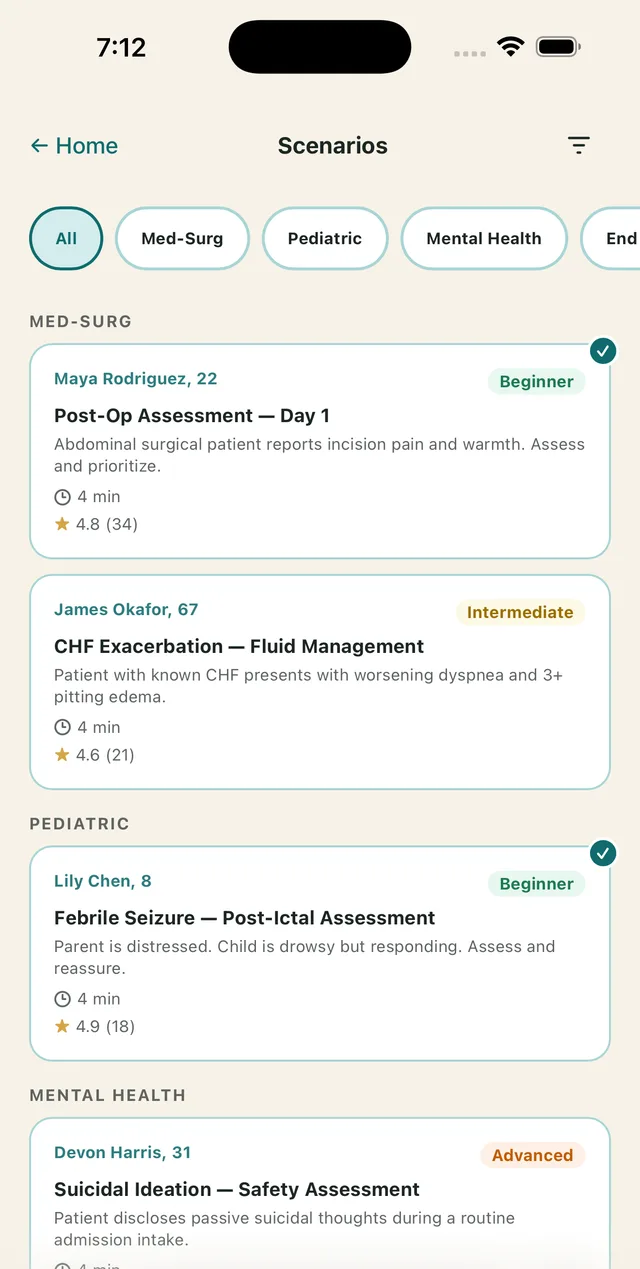
Pick a scenario
Browse 75+ clinical scenarios by domain: med-surg, peds, mental health, end-of-life, and more. Each one shows the patient's name, age, chief complaint, and difficulty level. Choose based on what's coming up.
Read the brief
Before the conversation starts, you see the patient's persona card: name, age, chief complaint, and three learning objectives. This is the same kind of brief you'd get before a clinical encounter.
Talk to the patient
The session is voice-only. The AI patient responds in real time based on what you say. Conversations run five to seven minutes. You can end early or let the timer close the session.
Get your feedback
Within about 30 seconds of ending the session, you get a percent score and coaching on therapeutic communication, clinical judgment, clinical assessment, humanistic care, and safety and escalation. The clinical judgment part is scored on the six steps of the NCSBN Clinical Judgment Measurement Model, the model the Next Gen NCLEX uses. How you talk with the patient is scored too, and that part is ours, not the exam's.
Practice again
If something didn't land, practice the same scenario again. The AI patient gives slightly different responses each time, so you're not memorizing a script. You're building a skill.


What it’s not
- —A chat app or text-based Q&A tool
- —A question bank. There are no multiple choice answers here.
- —Medical advice or clinical decision support
- —A replacement for your clinical hours
Hello Bedside is for practice only. Not medical advice, and not a substitute for your institution’s protocols.