That pit in your stomach before clinical? We get it.

Practice out loud with an AI patient. Get feedback in 30 seconds. No recordings. No one from your school watching. Just the repetition that makes hard conversations easier.

Live simulation screen — student talking to AI patient Maya Rodriguez, transcript visible, mic recording

Here’s how it works

SIM · MAYA RODRIGUEZ, 22 · AWAITING SCAN RESULTS
Patient says
“I’m really scared about what the scan results mean…”
You respond

say it out loud, not in your head

Feedback · 0:32 after session
  • You acknowledged her emotion well.
  • You asked an open-ended question to understand her fear better.
  • Try validating the family member’s concern next time. They’re often just as scared.
Try your first patient
That first clinical rotation. You’ve studied. You know the material. But you’ve never actually talked to a patient.”

Most nursing programs don’t give you anywhere safe to practice out loud before it matters. You step into clinicals with knowledge but without reps. Your preceptor’s watching. The patient’s waiting. Your heart’s pounding.

Hello Bedside is five to seven minutes in private. You pick the scenario. You talk like it’s real. An AI patient responds, and you get feedback on what landed and what didn’t.

No preceptor. No grade. Just the repetition that makes hard conversations feel less hard.

You’ll know what to say before it matters.

Built by a nurse

Dr Stacie A. Dee DNP, PMHNP-BC, CNE

11 years · Emergency medicine
Faculty · Hofstra Northwell School of Nursing

She wrote every rubric. She knows what matters at the bedside.

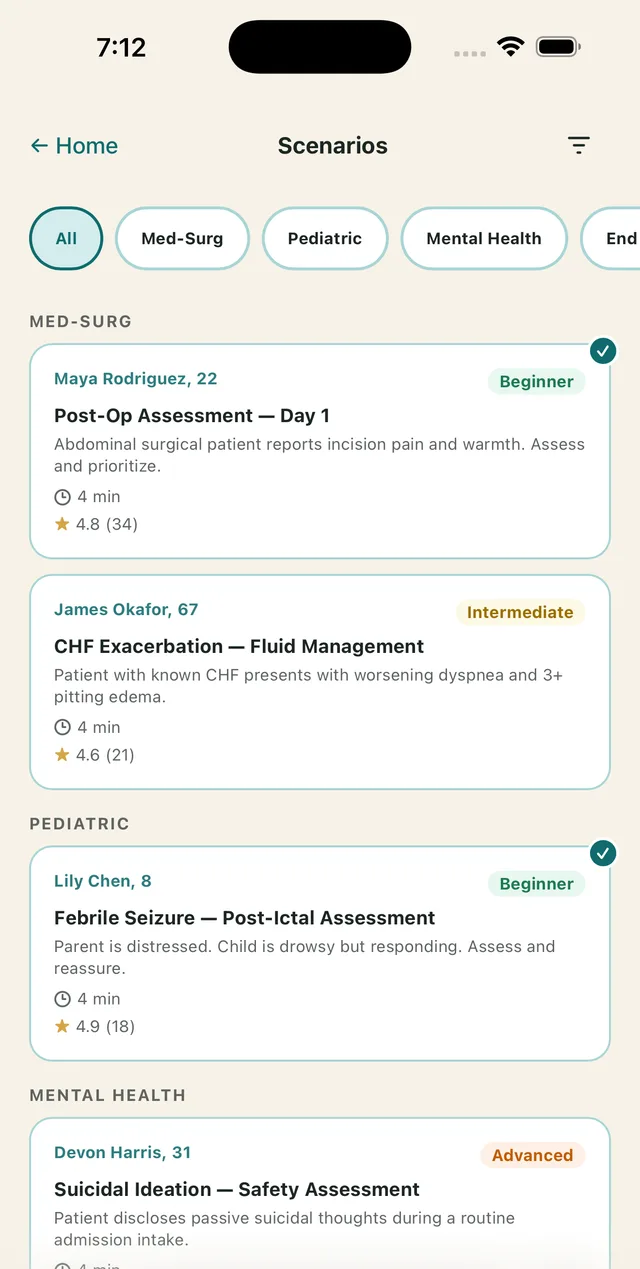
Pick your scenario

75+ real situations. Med-surg, peds, mental health, end-of-life, families. All mapped to what you're actually learning.

Scenario library screen with practice scenarios listed by domain and difficulty

Talk like it's real

Five to seven minutes. You on the phone, talking out loud. The AI patient answers in real time, and what it says next depends on what you just said. No pause button.

Active simulation screen showing live transcript between patient and student, with mic-on indicator and End button

Get your coaching

Feedback in four areas. What worked. What to try next. In 30 seconds. Built on rubrics written by someone who's actually done this.

Post-session feedback screen with coaching across four areas
Scenario library screen with practice scenarios listed by domain and difficulty
75+ clinical scenarios.

More added every month.

Med-Surg

Nathaniel Prosper, 77

Multiple Comorbidities, Rapid Decline

Pediatric

Two-month-old infant (accompanied by father Desmond Okafor), 0

Infant with Fever and Rapidly Worsening Appearance

Mental Health

Bettina Okafor-Lindstrom, 31

Escalating Agitation in Acute Psychosis

End of Life

Arthur Klein, 82

Advance Directive Conflict — Family Demands Full Code

Difficult Families

Josh Connelly (mother's boyfriend, speaking for Grace, age 4), 31

Bruises and a Story That Doesn't Match

NCLEX

Imani Barrow, 29

"Everyone Would Be Better Off Without Me" — Postpartum Day Three

Substance Use

Dashiell Okonkwo-Pruitt, 41

Complex Presentation with Family Conflict at the Bedside

Community Health

Danielle Foster, 42

Home Visit — Suicidal Ideation

Community Health

Herbert Williams, 72

Home Visit — Uncontrolled Diabetes

Critical Care / ICU

Ruth Blackwell, 74

Ventilated Patient — Comfort and Family Update

Browse the full library →

Dr Stacie A. Dee DNP, PMHNP-BC, CNE

Dr Stacie A. Dee DNP, PMHNP-BC, CNE


11 yrs Emergency Medicine · Hofstra Northwell Faculty

Dr. Stacie spent 11 years in emergency medicine and watched hundreds of nursing students step into their first patient conversation. This isn’t theoretical. Every rubric reflects a real situation she’s seen at the bedside.

She knows the gap between classroom knowledge and real conversations. She knows what confidence looks like. She knows what mistakes matter and which ones don’t.

She’s written every rubric because she knows exactly what matters when you’re standing at a patient’s bedside for the first time.

Also available for nursing schools →

It actually works.

I practiced the difficult conversation scenario three times. When my instructor asked me to counsel a post-op patient, I knew exactly what to say. My clinical eval scores jumped significantly.

Sarah K. — RN student, year 3
Marcus J. · BSN, final rotation
I was terrified of talking to families about code status. Bedside let me practice with an angry family member until I felt confident. It actually worked.

Choose your path to confidence

One-time purchase. No auto-renewal.

No data sold · Fully private · Access ends automatically

Your first patient costs less than a coffee. A 3-session pack starts at $5.99.

Buy the sessions you need, use them whenever you want. NCLEX Pass when the exam is close. Same app either way.


3 Pack

$5.99

3 sessions · no expiry

Try it before you commit to more. Sessions stay in your account until you use them.

Start with 3 →

10 Pack

$14.99

10 sessions · no expiry

Cover a full rotation without buying again. The best price per session.

Get the 10 Pack →

NCLEX Pass

$34.99

40 sessions · 60 days

Voice practice for Next Gen NCLEX. Scenarios built around clinical judgment, not multiple choice. You practice the reasoning out loud, not just the right answer.

Get the NCLEX Pass →

Session packs never expire. The NCLEX Pass ends after 60 days. On the App Store and Google Play.

“It actually worked.”

Marcus J. · Final rotation

Get paid for the recommendations you’re already making

Earn $1 to $12 for every classmate who buys a pass or session pack.

Open to nursing students at any school · Paid by PayPal, Venmo, or Zelle

If your classmates already ask what got you through clinical, tell them about Hello Bedside. Apply with your school email. Once you’re approved, your existing referral code starts earning.


Become a Student Advocate

10 classmates on the 10-Pack = $25, plus a $20 bonus for reaching Lead Advocate.

Example payout, not a guarantee

Questions from nursing students.


Is this AI safe to practice with?
Hello Bedside is for practice only. It's not medical advice and won't replace your clinical training or your school's protocols. The AI patient behaves like a real patient, not a medical reference - so you get realistic conversation practice.
Does Hello Bedside work for any nursing program?
Yes. Scenarios are mapped to the NCSBN Clinical Judgment Measurement Model and AACN Essentials Domain 2. They work across BSN, ABSN, ADN, and entry-level MSN programs, no matter where you're studying. What is NCJMM? →
What's the difference between Hello Bedside and apps like UWorld or Archer?
Those apps give you a question and tell you if you got it right. Hello Bedside makes you talk to a patient out loud and respond to what the patient says back. The skill is different: answer recognition vs. verbal clinical reasoning under pressure. Knowing the right answer and being able to say the right thing are not the same skill.
Can't I just practice this with ChatGPT?
You can, and some students do. But ChatGPT types back. Reading a good answer on a screen is not the same as saying it out loud while a patient waits for you. It also won't score you against a clinical judgment framework or remember what you've already practiced. Hello Bedside is voice only. Every session gets scored, and you can come back to the same encounter and run it again until it stops feeling hard. See the full comparison →
Is Hello Bedside only for students close to NCLEX, or does it work earlier in nursing school?
It works from your first clinical onward. Difficulty starts at Day 1 fundamentals: basic patient assessments, introductory conversations. It goes up to advanced emergencies and ethical dilemmas. Students grab a session pack before any rotation, not just the final one. If you've never talked to a patient before, that's exactly who Hello Bedside is built for. Read: how to prepare for your first clinical →
Does Hello Bedside help with the Next Gen NCLEX?
Yes. The Next Gen NCLEX tests clinical judgment through unfolding case scenarios, prioritization, and reasoning, not recall. That's a skill you build by practicing, not by reading rationales. The NCLEX scenario library includes those case types. You practice the reasoning out loud. Read: how to practice clinical judgment →
What if my school already uses NurseKind?
Hello Bedside is completely separate from the institutional product. It's your own app, on your own device, not connected to your school's account. Total privacy.
Will my school know I'm using Hello Bedside?
Nope. Hello Bedside is completely private. Your school has no visibility into your practice sessions. It's just you, your phone, and getting better on your own time.
What if I mess up in a scenario?
That's the whole point. No audio recordings, no academic grades, nothing shared with your school. You mess up, you learn what to adjust, and you practice it again. That's how you build real confidence. Read: preparing for a hard conversation →
How much practice do I need?
Three to five scenarios per rotation usually gives you a solid foundation for the situations you'll see. But honestly, even one session helps. Session packs run from 3 to 10 sessions with no expiry, so you can pick a size and keep going as long as you need. Read: how to practice therapeutic communication →
How do I get help?
Email support@hellobedside.com. We get back to you within one business day.
Practice before it counts.

Feel ready. Start practicing.